
LCL vs FCL: How to Choose Your Ocean Freight

The first ocean freight quote you receive is a wall of acronyms: THC, BAF, CFS. But the decision underneath is simple. Does your cargo fill a container on its own (FCL), or do you share one (LCL)? That single choice drives your pricing structure and your cost.
This guide helps anyone new to ocean freight read a quote and decide between LCL and FCL with confidence.
Ocean Freight Basics: LCL and FCL
- FCL (Full Container Load): one shipper uses an entire container. Only your cargo is inside, there is no consolidation, and you are billed a flat rate per container.
- LCL (Less than Container Load): cargo too small to fill a container. Multiple shippers' goods are consolidated into one container and split at a CFS (Container Freight Station). You are billed by volume (CBM).
LCL vs FCL: The Break-Even Is Around 12-15 CBM
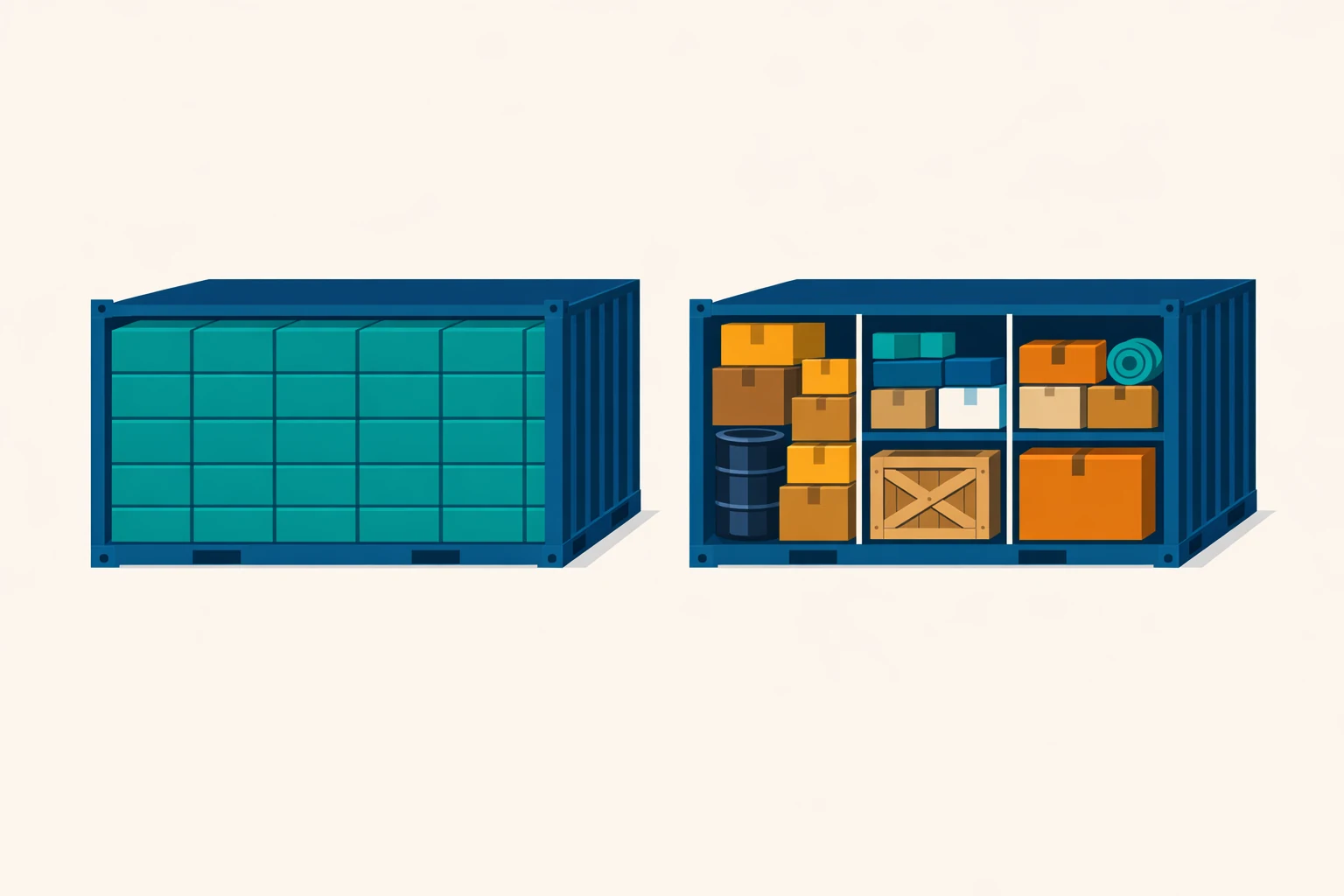
| FCL | LCL | |
|---|---|---|
| Container use | Dedicated | Shared |
| Billing basis | Flat per container | Volume (CBM) or R.TON |
| Consolidation | None | At CFS (CFS charge) |
| Risk | Lower (your cargo only) | Affected by co-loaded cargo |
| Best for | Larger loads (~12-15 CBM+) | Small loads |
Break-even: as a rule of thumb, FCL becomes cheaper than LCL once cargo reaches 12-15 CBM. Because this varies by lane, rate, and peak season, the surest approach is to request both quotes and compare.
Note: a 20ft container holds roughly 25 CBM in practice, and a 40ft about double. The closer your total CBM gets to container capacity, the more clearly FCL wins.
CBM and Revenue Ton: How Ocean Freight Is Priced
- CBM (Cubic Meter): 1 CBM is a box 1m x 1m x 1m. Multiply each carton's dimensions (in meters) and by quantity to get total CBM.
- R.TON (Revenue Ton / Freight Ton): for LCL, the carrier bills on whichever is greater, weight or volume. It compares 1 CBM against 1,000 kg and charges by the larger figure. Light but bulky cargo is billed by volume; small but heavy cargo by weight.
What Makes Up an Ocean Freight Quote
The total is not one number but a stack of line items.

- Ocean Freight: the base port-to-port transport cost
- THC (Terminal Handling Charge): terminal handling at both ports
- BAF / CAF: fuel (BAF) and currency (CAF) adjustment surcharges
- CFS Charge: LCL consolidation/deconsolidation (not applicable to FCL)
- DOC (Documentation): B/L and document issuance
- LSS / PSS: low-sulphur fuel (LSS) and peak-season (PSS) surcharges
- Others such as WFG (port facility fee), inland drayage, and customs may apply.
The key to comparing quotes: carriers differ in which charges they fold into ocean freight and which they list separately. Compare the all-in total, not the ocean freight line alone.
Practical Checklist
- Calculate total CBM first and compare it against container capacity to make an initial LCL/FCL call.
- Compare on the all-in total. A low ocean freight line often flips once surcharges are added.
- Confirm the Incoterms (FOB/CIF, etc.) so you know who pays for what.
- Watch for peak-season and lane-specific surcharges (PSS) alongside the schedule.
This guide is for general information. Actual rates, break-even, and surcharges vary by lane, carrier, and timing. Confirm costs with a quote.
Frequently asked questions
What is the difference between LCL and FCL?
FCL means one shipper uses an entire container; LCL consolidates multiple shippers' small shipments into one container. FCL is billed flat per container, while LCL is billed by volume (CBM).
When does FCL become cheaper than LCL?
As a rule of thumb, FCL becomes cheaper once cargo reaches about 12-15 CBM. Because it varies by lane, rate, and season, requesting both quotes and comparing is the surest way to decide.
How do I calculate CBM?
1 CBM is a box measuring 1m x 1m x 1m. Multiply each carton's length, width, and height in meters, then multiply by quantity to get total CBM.
What is a revenue ton (R.TON)?
For LCL, it is the billing unit taken as the greater of weight or volume. The carrier compares 1 CBM against 1,000 kg and charges by whichever is larger.
What should I compare on an ocean freight quote?
Compare the all-in total including THC, BAF, and CFS rather than the ocean freight line alone. Carriers differ in what they bundle versus list separately, so totals often flip.


